Every Ontarian knows that it is peach season and we all have the sticky, smiley faces to prove it.
But living alone, one has got to be creative when finding a way to eat through a basket of peaches. They were just $2.77 at No Frills, but not one peach was ripe.
What to do!?
Showing posts with label food with a conscience. Show all posts
Showing posts with label food with a conscience. Show all posts
Thursday, September 8, 2011

Wednesday, December 22, 2010
Acquerello is “the Rolls Royce of rice"
I brought the spoon to my mouth. On it, a few grains of creamy white risotto. The grains held their shape as I played with them between my tongue and the roof of my mouth, rolling them around. The risotto looked like it had been made with only rice and stock. The only ingredient I could discern was rice and so I erroneously expected something bland. The grain itself was so flavourful that I immediately understood the chef’s choice to keep the dish simple: so that the rice could shine. Among the layers of flavour, I tasted notes of toasted nuts, (almost smoky) oak, salty Parmesan and hints of umami (likely from a chicken stock). The dish was so special, so refined to perfection that I was able to keep my composure and eat at an appropriate pace. (Despite being tempted by the sizable flat spoon, which would have made an effective shovel.)
The large, flat plate showcased the single layer of pearly rice – each moist grain covered in a light sauce and dusted with Parmesan. It was far from the sticky, starchy risotto that I’m used to, which made me consider that perhaps the chef had cooked the risotto, rinsed it and then covered it lightly with sauce. If this was the case, the steps were too ingenious to be called cheating. In the centre of the risotto, a small white rectangle of lardo sat atop a small heap of smoked eggplant, encircled by dots of purple lavender oil. Cold and sweet, the lardo added depth; the tangy eggplant brightened the dish; and the lavender brought out the floral notes of the grain. By creating a dish that highlighted the rice so entirely, it was apparent the chef was presenting a product that he admired. He had even written the brand of risotto he had used on the menu: Acquerello.
When I returned home that night I went straight to the computer to find out what exactly made Acquerello risotto so different from any risotto I had ever had.
Risottos and paellas are best made from medium grain rice, which can absorb liquid while remaining firm. Harold McGee explains in On Food and Cooking, that medium-grained rice, which is 2-3 times longer that it is wide, contains less amylose (starch in the centre of the grain) than long-grain rice and therefore requires less water when cooking. The grains are able to cook until tender without becoming starchy. That is, the grains cling to each other, but they don’t stick. The starch content, with the addition of stock, is what creates the sauce for the rice. A well-made risotto should look like pearls of rice within a sauce, not a gluey mash. The starch content and size of Acquerello’s Carnaroli rice are the foundations for a perfect risotto.
Although Arborio may come to mind when searching for rice to make risotto, many risotto lovers prefer Carnaroli or the lesser known, Vialone Nano. Arborio rice makes a stickier, starchier risotto because the grains do not absorb liquid as well. If Arborio is all you can find, superfino is your best option, as its starch content results in a creamy -- not sticky -- risotto. At The French Laundry in California, Chef Thomas Keller cheats a little by folding in a bit of whipped cream to his finished risotto to give it a lighter consistency! Chefs around the world prefer Carnaroli and don’t mind spending a bit more for such a special product. It has been called the “caviar of rice” – and although it isn’t as expensive as caviar, it does cost more than Arborio. Carnaroli is one of the most difficult types of rice to grow, and therefore expensive – compared to other types of rice. The Cheese Boutique sells 500g tins (enough for about 6 portions) of Acquerello for $10.99.
Acquerello means watercolour, a name perhaps inspired by the picturesque Piedmont landscape, where the rice is grown. Just outside of Livorno Ferraris, in the province of Vercelli (the rice capital of Europe), 140 hectares of bright green rice paddies surround the beautiful clay-coloured Colombara estate. In the distance, the white Alps pierce the crisp blue sky. For three generations, this is where the Rondolino family has grown Carnaroli rice for their company, Acquerello.
Acquellero’s Carnaroli rice is organic and environmentally friendly; much of the planting, weeding and harvesting is done by hand. The paddyfields of growing rice provide a thriving ecosystem for including frogs, dragonflies and herons.
In October. ninety percent of Acquerello rice is harvested and aged for one year. The other ten percent is aged for three years. As the raw rice matures in chilled silos, oxygen changes the chemical composition of the outer layer of starch (called amylopectin); the rice becomes less water-soluble, meaning it is able to absorb more liquid. The high amylose content of Carnaroli is like the backbone for the rice – maintaining the grain’s shape as it absorbs all that liquid. The cooked grains are larger than most risotto and far more flavorful. The outer layer contains the most flavour, and so it is important that when the rice is milled, this outer layer is not damaged. Using a method abandoned by many rice cultivators, the Rondolino family uses a propeller to gently tumble the rice, which polishes the rice over ten minutes, as opposed to the rough six second refining method used most often in northern Italy today.
To show off each grain of rice, risotto must be a homogenous dish, with the silky liquid holding together the grains in a single layer. You can achieve this perfect presentation by ensuring you start by toasting your medium-grain rice. Toasting releases the rice’s natural nutty flavour, but it also brings the rice closer to the temperature (70-73°C) required for the starches to lose their crystalline structure in order to absorb more liquid. This temperature differs with both short and long grain rice. It’s not necessary to stick a thermometer into your rice – not at all – but it is important to keep your flavourful stock just below simmering (80°C) in a separate pot so that when you ladle it into your rice, the temperature remains constant. Taste often and season along the way. When the grains still hold their shape, but are no longer crunchy, your risotto is done. Off the heat, add a knob of cold butter and a few tablespoons of freshly grated Parmesan to give the risotto a nice sheen, and then call your guests to the table. When you are plating, ladle a scoop in the centre of your plate and smack the bottom of the plate to disperse the risotto into a single layer of rice.
Around the world, Michelin starred and award winning chefs cook with Acquerello rice. Heston Blumenthal, alchemist and chef at The Fat Duck in London, England chooses his risotto rice based on texture, mouth feel, creaminess, and one that is not too sticky. He uses Acquellero risotto to create his perfect risotto: served with toasted rice butter, frozen saffron butter and mushroom powder.
French chef, Alain Ducasse has praised Acquerello as, “the Rolls Royce of rice".
Grown with love (and organically!), Acquerello rice has it all: complex layers of flavour, the perfect starch content, and the approval of chefs around the world. If you cannot find Acquerello, use any brand of Carnaroli rice. As long as it is made with love, your risotto will be perfect.
Wednesday, July 28, 2010
When it's too hot for Guinness, grab a Flying Monkey
I am a writer, cook, and a lover of Guinness.
This week, I have been mostly just sweaty and thirsty.
I like Guinness. A lot. When Guinness isn’t available, I drink O’Haras Celtic Stout. A few degrees hotter, I drink Mill St. Tankhouse Ale. I like my beer to taste warm with spice but there is no room for cloves and cinnamon when it is pushing 35˚C in the downtown core. That is a fact. The result is that I was thirsty for a full week - before I found Flying Monkeys' Hoptical Illusion.
My predicament is that I really do not like the typical hot weather beers. Steam Whistle and Corona? Blech. I like beer that tastes nutritious.
When it’s too hot to eat, a swig of Hoptical Illusion will fill those pangs of hunger with salubrious bitter spice and refreshing hoppy tang. This “Almost Pale Ale” will quench your thirst when it is too hot for Guinness. Once quenched, look under the cap for messages like, “ May the beer be with you” and “ Carpe Beerum. Seize the Beer”.
The taste, the packaging and the fact that it is local makes me smile. You should try this beer.
The Toronto Beer Festival will be running from August 5th until the 8th and the guys from Flying Monkeys will be there.
Flying Monkeys Craft Brewery is located in Barrie, Ontario (Yay local! Yay independent!)
A case of 6 beers (5% alcohol) is $12.95, available at the LCBO. Look for the wild packaging.
Saturday, June 5, 2010
Grow Some Beans

Beans may not always have the best reputation, but they really are something to honor. They are little fighters -- producing pod after pod of nutritious beans from now until the fall. Think of how proud you would be to serve a bean salad made entirely from beans you harvested! And when you have had enough of beans -- because every morning you will have more pods ready to pick -- then you can shell the pods and lay the beans on a tray to dry in the sun. Once dry, pour them into some jars.
Come winter your pantry will be fully stocked and ready for all your winter comfort foods. You may not be craving a bubbling hot cassoulet now, but when you do, you'll be prepared.
How to Grow Your Own Beans
Beans are wonderful because just one plant can produce so many pods. This means if you live in an apartment, you can grow your beans on your porch, or by a window. Direct plant them. Beans don't like to be transplanted, so where you plant them it where they shall stay. Sow the seeds this week and in about 75 days you will have bean plants with pods beginning to appear in plenty. Let pods dry on the plant -- they should feel papery and come off the branch easily. Shell them and lay the beans on a tray in the sun to dry out. Once dry, after a day in the sun, jar them.
It's time to grow some beans!
Click here for more information about beans
Click here for more information about how to plant them.
How to Cook Your Own Beans
The night before you are planning to eat your beans, put 1 part beans to 5 parts cold water in a large container. One cup of dried beans yields about 3 cups cooked. NEVER add salt at this time; Salt does something funny to beans and stops them from absorbing water ( it's an osmosis thing). Leave your beans overnight. The next morning, drain and rinse your beans. Add beans to a pot with water (same ratio of as before). Once the water comes to a boil, turn down the heat and simmer for 20 minutes. Ok, *now* you can add your flavours ( bay leaf, salt, peppercorns, carrots, celery, or whatever you feel like). Continue simmering for about another 40 minutes. When the beans are tender, they are ready. Drain but don't rinse. Even if you are making a cold bean dish, add the dressing when the beans are still warm. They will soak up the dressing and be super delicious. If you need them to cook down fast, lay them on a cling film-lined baking tray.
Other Benefits of Growing Your Own Beans:
- Canned beans are cheap, but not as cheap as dried beans!
- Canned beans have tons of salt
- Canned beans require cans, therby creating more waste
- Canned beans are heavy, and so transporting them uses a large amount of pollution
...and most importantly:
- You get to be close to your food: See it grow and appreciate it that much more

Photo of Trionfo Violetto beans by S. Irene Virbila
Friday, April 30, 2010
Escargot a la jardin
...or in English: Snails from the garden. Sounds much better in French, doesn't it?

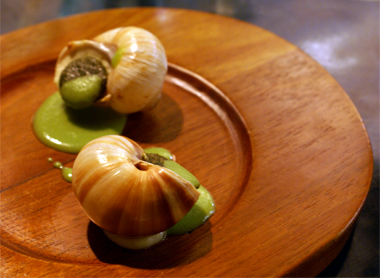
If you won't eat snails from your garden in the name of sustainability, and if their incredible nutritional breakdown* doesn't get you excited, then you will just have to cross your fingers that the time and effort ( and butter) you put into preparing this dish will give your the courage to have a taste. Escargot is rich and tasty and if prepared properly, its soft tenderness is pleasantly surprising.
*100 grams of snail contains 16g protein, 2 grams of carbohydrates and 1 gram of fat ( high in omega-3 fatty acids). Also, from 100 grams of snail you get a whopping 19% of your recommended daily intake (RDI) of Iron, 25% RDI of Vitamin E and 40% RDI of Selenium!
I figure, killing snails will be like killing a chicken. There is a point - between gutting the warm animal and butchering - that the chicken starts to look like food. This is going to be gut-wrenching for me as I have made serious efforts to avoid the cute slow-movers and shiver toe to head when I hear a crunch beneath my foot.
Snails take 7-10 days to get ready, so by that point, maybe I will be more keen to eat them.
Below are instructions adapted from Pat and Bob Reynolds' recipe ( one that the BBC used: here)
Step 1: Collect snails (Helix Aspersa) in a container. As an appetizer, a serving is about 7 snails per person. So let's assume you've dragged 3 friends into this endevor and collect about 30 snails.
Step 2: Cover the container VERY tightly with mesh or something that will allow the snails to breathe but not escape ( can you imagine waking up to an army of snails marching towards you in slow motion? Horrifying!
Step 3: For 7-10 days, feed the snails cabbage or lettuce. (If you want organic snails, feed them organic lettuce.) This cleans them out much the same way as feeding cornmeal water to shellfish*. Good, edible stuff goes in and sandy, gritty stuff comes out.
*Did you know snails are terrestrial mollusks?
Step 4: Plop your friends into a sieve and then dunk them in boiling water. This is to kill them, not cook them, so only keep them in the water for a few seconds.
Step 5: Use a fork to pull the snail from its shell. Keep the shells in one bowl ( they are nice for presentation purposes) and the snails in another. Give the snails a rinse under lukewarm, running water.
Step 6: In a pot, combine:
160ml water
100ml dry cider,
One small carrot, roughly chopped
One small white onion, roughly chopped
The snails*
*Make sure they are covered with liquid. Add a bit more water if they are not.
Step 7: Bring to a boil and then turn the heat way down and let them simmer for about 40 minutes.
Meanwhile: Boil the shells in salted water, rinse in cold water and repeat two more times. Put the shells on a tray and dry them in a warm oven.
Step 8: Nothing like a bit of butter to take away your worries.
In a small bowl, mix together the following:
1/4 lbs salted butter, room temperature.
½ tsp fresh Chervil, chopped finely
½ tsp fresh Dill, chopped finely
½ tsp fresh Basil, chopped finely
½ tsp fresh Sage, chopped finely
3 teaspoons fresh Parsley*, chopped finely
Pinch of Cayenne Pepper
*Curly parsley is easier to cut, but often sandier. Flat leaf parsley has more flavour.
While you're chopping herbs, finely chop some chives, and save some parsley, which you can use as garnish.
Step 9: I bet you're starting to get hungry. You may even be talking to your snails now, threatening them that they better be delicious after all this hard work and time you've put in. Push a little of the butter mixture into the shell, right to the back. Put in the snail and then seal him in there with more delicious herby butter. You can do this ahead of time, and keep them in the fridge after assembled, or you can cook them right away.
Step 10: To serve, place the escargot de la jardin on escargot trays ( or on a baking sheet if you don't have one) and into a hot hot oven. When the butter bubbles, they are ready. Serve with crusty bread.
 The photo above was taken by Mellie at five star restaurant, Vue de Monde

If you won't eat snails from your garden in the name of sustainability, and if their incredible nutritional breakdown* doesn't get you excited, then you will just have to cross your fingers that the time and effort ( and butter) you put into preparing this dish will give your the courage to have a taste. Escargot is rich and tasty and if prepared properly, its soft tenderness is pleasantly surprising.
*100 grams of snail contains 16g protein, 2 grams of carbohydrates and 1 gram of fat ( high in omega-3 fatty acids). Also, from 100 grams of snail you get a whopping 19% of your recommended daily intake (RDI) of Iron, 25% RDI of Vitamin E and 40% RDI of Selenium!
I figure, killing snails will be like killing a chicken. There is a point - between gutting the warm animal and butchering - that the chicken starts to look like food. This is going to be gut-wrenching for me as I have made serious efforts to avoid the cute slow-movers and shiver toe to head when I hear a crunch beneath my foot.
Snails take 7-10 days to get ready, so by that point, maybe I will be more keen to eat them.
Below are instructions adapted from Pat and Bob Reynolds' recipe ( one that the BBC used: here)
Step 1: Collect snails (Helix Aspersa) in a container. As an appetizer, a serving is about 7 snails per person. So let's assume you've dragged 3 friends into this endevor and collect about 30 snails.
Step 2: Cover the container VERY tightly with mesh or something that will allow the snails to breathe but not escape ( can you imagine waking up to an army of snails marching towards you in slow motion? Horrifying!
Step 3: For 7-10 days, feed the snails cabbage or lettuce. (If you want organic snails, feed them organic lettuce.) This cleans them out much the same way as feeding cornmeal water to shellfish*. Good, edible stuff goes in and sandy, gritty stuff comes out.
*Did you know snails are terrestrial mollusks?
Step 4: Plop your friends into a sieve and then dunk them in boiling water. This is to kill them, not cook them, so only keep them in the water for a few seconds.
Step 5: Use a fork to pull the snail from its shell. Keep the shells in one bowl ( they are nice for presentation purposes) and the snails in another. Give the snails a rinse under lukewarm, running water.
Step 6: In a pot, combine:
160ml water
100ml dry cider,
One small carrot, roughly chopped
One small white onion, roughly chopped
The snails*
*Make sure they are covered with liquid. Add a bit more water if they are not.
Step 7: Bring to a boil and then turn the heat way down and let them simmer for about 40 minutes.
Meanwhile: Boil the shells in salted water, rinse in cold water and repeat two more times. Put the shells on a tray and dry them in a warm oven.
Step 8: Nothing like a bit of butter to take away your worries.
In a small bowl, mix together the following:
1/4 lbs salted butter, room temperature.
½ tsp fresh Chervil, chopped finely
½ tsp fresh Dill, chopped finely
½ tsp fresh Basil, chopped finely
½ tsp fresh Sage, chopped finely
3 teaspoons fresh Parsley*, chopped finely
Pinch of Cayenne Pepper
*Curly parsley is easier to cut, but often sandier. Flat leaf parsley has more flavour.
While you're chopping herbs, finely chop some chives, and save some parsley, which you can use as garnish.
Step 9: I bet you're starting to get hungry. You may even be talking to your snails now, threatening them that they better be delicious after all this hard work and time you've put in. Push a little of the butter mixture into the shell, right to the back. Put in the snail and then seal him in there with more delicious herby butter. You can do this ahead of time, and keep them in the fridge after assembled, or you can cook them right away.
Step 10: To serve, place the escargot de la jardin on escargot trays ( or on a baking sheet if you don't have one) and into a hot hot oven. When the butter bubbles, they are ready. Serve with crusty bread.
Friday, March 26, 2010
Farmed fish is not always the sustainable option
If you think your fish is sustainable because it is farmed, think again.
Have you thought about what your farmed fish ate? You might have, after you read How did Chef Dan Barber fall in love with fish? . In his TED talk, Chef Barber spoke about the optimal fish feed. He didn't talk about the majority of fishmeal producers, who pulverize fish into a pulp to feed to their farmed fish -- that eat more and grow larger than in nature. For more information about fishmeal producers, watch this video: The Greed of Feed
In some cases, such as with Salmon, farmed fish is more sustainable -- as long as the fish farm is inland ( so that the fish cannot escape into the wild, as many coastal farmed fish do). If the location of the fish farm is unknown, buying fish that has been caught by long line fishing is optimal.

It is never okay to buy fish that has been caught by trawl ( dragging a net as big as football field along the ocean floor, collecting everything that gets in its way) or by gill-netting ( which is a giant curtain, capturing anything that tries to swim through). For more information on fishing methods, click here
The most important thing to remember is to eat in moderation. Have fish a maximum of once a week. Fish that are not endangered (yet) still risk being over fished. Cod, for example, has been overfished everywhere and so at the moment, the best source of cod is in Alaska, but that doesn't prevent overfishing there too. Take a break from all cod, salmon and tuna. There is no reason you cannot substitute fish for a more sustainable, environmentally friendly and equally nutritious alternative, such as hemp. ( more information on Hemp to come, but for now, check this out: click here)
Here is a list of the most sustainable fish options:
Haddok - hook and line caught from Canadian Atlantic
Mackeral ( aka Cavalla, King, Kingfish, Smoker, Slab, Hog) - hook and line from Atlantic, Gulf of Mexico
Sablefish (aka Skilfish, Skil, Coalfish, Sable, Black cod, Gindara) - caught bottom longline in Alaska
Swordfish - caught by harpoon or handline in U.S. Atlantic, U.S. Pacific, Canadian Atlantic. Take note that it does have a high mercury content.
And for something a bit unusual, try Red Sea and Green Sea Urchin, dived for and gathered by hand. Red sea urchins are found in the Pacific Ocean from Baja, California up to Alaska. Green sea urchins live in both Atlantic and Pacific Oceans. Both types of urchin are prized for their roe. Urchin roe is popular in Japanese restaurants , sold under the Japanese name uni ( pictured below).

Saturday, February 13, 2010
Slow for Sloe: How to Make Your Own Sloe Gin

Visiting the Plymouth Gin Distillery – how could I not? - I saw a glass shelf proudly displaying row upon row of Sloe Gin. The ruby liquid, sparkling through the glass bottle, whispered my name and drew me closer.
Mesmerized, I asked what made this gin ‘sloe’. "Sloe gin," the tour guide replied, "is made from distilling gin with sloes." She described them as berries, bigger than junipers and then another woman added, " They taste like blackcurrent." I love blackcurrents! (I especially adore Ribena). Spirits writer, Jason Wilson describes sloe gin as having " a unique crisp and tangy taste (a balance of sweet and bitter that’s not cloying) and a faint, subtle finish of almonds.” The bitter almond aftertaste is from the sloe pits.
Sloes (Prunus spinosa ) are bitter and astringent stone fruits, much less sweet than the other members of the plum family. Damson plums can be instead, resulting in a sweeter liqueur-type gin, if that is what you fancy. I prefer my drinks with minimal sugar ( the benefit is that I can have a lot more of them, and feel great the following morning).

Picked from the blackthorn tree in late Autumn, sloes are gathered and weighed. One pound of sloes is needed to turn one bottle of gin into sloe gin. The sloes are pricked all over to allow the juice to easily steep into the gin. In a sterilized jar, 170g of caster sugar is poured over the pricked sloes, followed by one litre of gin. The jar is then sealed tightly, shaken up and left in a cool, dark place. The jar needs a good shaking every other day for a week and then once a week for three months.
I imagine I would be tempted to try little sips along the way, but avoid the urge to stick a staw in to gulp it all up as it could contaminate and ruin everything. Instead, dip a metal spoon in boiling water to sterilize it, and without touching the inside of the jar with anything unsterilized, dip the spoon in and have a taste. No double dipping.
Garnet and ready to drink after three slow months of painful anticipation, the gin can now be called sloe. Although, if you do have some patience, wait two more months and the flavour will be perfectly rounded. Some people can wait one full year, but I know I wouldn’t be able to.
A woman sitting across from me at lunch yesterday made me tingle with eagerness when she said that after four months she strains her sloe gin into a bottle and then removes the pits from the remaining gin-soaked sloes and dips them in dark chocolate. Delicious.
Sadly, Canadians must order sloes online if the homemade version is what you are after. Some websites suggest eBay.
 Authenticity comes with a price. A number of gin drinkers worldwide claim Plymouth’s Sloe Gin is the best there is. They have used the same recipe since 1883, so I should think so. Canadians can order it online for $93.62 from DrinkUpNY or from the Plymouth Gin Website for £17 ($26) plus shipping and handling. Gordon’s also makes a beautiful, authentic sloe gin that I wouldn’t mind trying.
What I do not recommend is McGuiness Sloe Gin. It is cheaper, lower quality, syrupy and sickly sweet sold at the LCBO for $18.95. (Unless of course you are having a reckless night of drinking everything and anything, including Alabama Slammers)
Wondering if I could still have my sloe gin with tonic, I was assured I could, or I could have something wonderful called a ‘Gin Fizz’
» 1 oz sloe gin
» 1 oz plain gin (I suggest Bombay Sapphire or Tanqueray 10)
» 3/4 oz fresh lemon juice
» 1 oz simple syrup
» 3 to 4 oz club soda

picture courtesy of Niagara
Friday, February 5, 2010
If it isn’t magical, it cannot be called Stilton

Stilton is not my favourite cheese but I do love it very much. Its creaminess protects the roof of my mouth and calms the penicillin mould, which I sometimes find a little too tangy in some cheeses such as Roquefort.
Stilton has its own website because it is, after all “Britian’s favourite cheese” with “magical blue veins”. The website provides a link to The Culinary Guide with a mouth-watering recipe for Stilton Risotto With Sausage, Spring Greens And Crispy Sage. So loved in fact, that there is an annual Stilton Cheese Rolling Championship. If you haven't seen cheese rolling, you will enjoy the unexpected community enthusiasm: Click here for a video. I promise it isn't nearly as shocking or painful as the Gloucestershire cheese rolling: Click here)
Although Stilton freezes well (*thaw it in the fridge slowly when you are ready to eat it), I had planned to consume the entire wedge - mostly by myself - by the end of the week, or maybe I should say two weeks, to avoid being quite so evidently gluttonous.
Stilton has been made since the 18th century. To stay as true as possible to the original recipe, The Stilton Cheesemakers' Association has prescribed the following rules:
- It can only be produced in the three Counties of Derbyshire, Nottinghamshire and Leicestershire
- It must be made from locally produced milk that has been pasteurized before use
- It can only be made in a cylindrical shape
- It must be allowed to form its own coat or crust
- It must never be pressed and
- It must have magical blue veins radiating from the centre of the cheese
I especially like the last point. If the cheese does not adhere to every single one of the aforementioned points then it cannot be called Stilton.
The cheese’s unique flavour and texture demonstrates why it is important to follow the rules. It melts and crumbles easily so it is wonderful for salads as well as baked with figs and onions in a tart.
 One week after buying the cheese, I have had it in salads, on bread, and in a frittata. I have finished half the wedge and am now worrying that I have too many recipes and not enough cheese!
For Stilton recipes, click here
Tuesday, January 26, 2010
Clotted cream leaves me speechless and unable to come up with titles
"You really are as thick as clotted cream, that's been left out by some clot, and now the clots are so clotted, you couldn't unclot them with an electric de-clotter, aren't you, Baldrick?" - Blackadder Back & Forth
When I think of English food I think of fish and chips wrapped in newspaper, fat sausages glistening beside mashed potatoes, better milk chocolate than Canada’s and crisps of every flavour. Little did I know I was leaving out the best of the pale-coloured English treats: clotted cream. When I was devouring my first cream tea (freshly baked scones, smeared first with clotted cream and then sticky dark strawberry jam) I mourned for all the years I have lived without this gooey, buttery wonder.

In the 15th century 'clowted crayem' became known as a luxury food when a writer noted that clotted cream should be enjoyed more for ‘a sensual appetite than for any good nourishment’. ‘Clotted’ could imply the resulting arterial condition of the clotted cream eater, but the name is actually thought to originate from ‘clout’, or ‘clowt’, an old word for a patch of cloth, which is what the crust on the cream resembles. When I was enjoying my clotted cream and staring at it intently, trying to figure out how it was made, I noticed patches of this thick crust made of sandy grains of yellow. I et them up too and loved the slightly sandy texture on my tongue.
In Devon, clotted cream is also known as Devonshire cream or Devon cream, but in Cornwall, where they also claim its origin, it is called Cornish clotted cream and holds a PDO (Protected Designation of Origin). Cornish clotted cream is a bit runnier than the former and therefore needs to be drizzled over the scone after the strawberry jam.
It is believed that around 300BC Phonenician traders visited what is today Cornwall and traded tin in exchange for the knowledge of how to make clotted cream. Today, the few other places in the world that make clotted cream include Lebanon and Syria where it is called qishta or qashtah. A version made with milk from water buffalo is made in Turkey, where it is known as kaymak.
Cornwall and Devon make exceptional clotted cream because the cows produce milk with a very high butterfat content. Cornish clotted cream (PDO) must have a minimum butterfat content of 55% although the average is usually closer to 60%. Dairy farmers in these areas claim it is the cool ocean breeze that helps grass grow abundantly to feed their cattle. Yet still, each creamery produces their own unique clotted cream because there are so many variables that influence the resulting product, including the breed of cow, what it eats, where it lives, the climate and the precise method to produce clotted cream.
The sticky clotted cream actually held my fresh, crumbling scone together at one point, at which I smiled at the perfection of the pairing. I have since happily read and agreed wholeheartedly that clotted cream is excellent served with Christmas Pudding. Not as popular today - but probably equally delectable - is cockles and cream, which was once a reason in itself for travelers to voyage to the Dart Valley.
Since I am in Devon, I will certainly be eating clotted cream again soon, frequently and in large quantities. For those of you in Canada, do not fear: you still have a chance to fatten up on clotted cream, but you will need to work for it. Here is a recipe:
How to make Clotted Cream:
It takes 6 pints of milk to produce half a pound of clotted cream. You can store it so don’t worry that you will have to eat it all at once – although you may do so, regardless.
Day 1: Pour 6 pints of whole milk* into a metal or heatproof glass bowl and leave it to stand in a cool place overnight. . This is the only ingredient so make sure it is the best milk you can find (i.e. fresh, organic, local). If you own a cow, use raw milk.
*Do NOT use homogenized milk. Homogenized milk is made by homogenizing whole milk, meaning the fat globules in the milk have been broken up so that they spread evenly throughout the milk, which prevents a creamy layer forming at the top. If you live in the U.K, buy Breakfast Milk’s unhomogenized Gold Top milk, which is made with Channel Island milk.
*If you live in Canada, I would suggest you use Harmony Whole Milk, which isn’t homogenized.
Day 2: By morning, your cream should have separated. Do not stir it. Fill a pot ¼ of the way with water and fit the bowl on top. The bottom half of the bowl should fit into the pot but should not be touching the water. For an image, click here (in this image the pot should be slightly larger or the bowl slightly smaller)
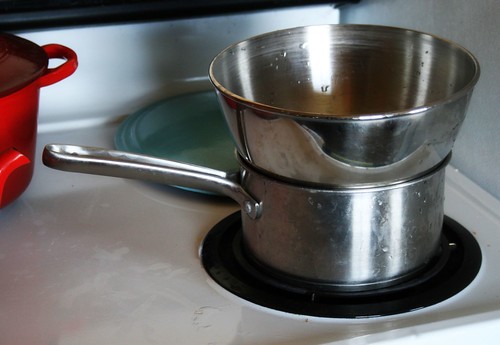
Heat gently to 82 C to scald the milk, but do NOT let it boil. Do not stir. Check the water level in about half an hour and refill if it has evaporated. After about 1½ - 2 hours it should have a thick uneven crust.
Remove the dish from the heat and leave it to stand in a cool place overnight, or until the cream underneath the crust reaches 45 C.
Day 3, or when the cream reaches 45 C: The cream can now be skimmed off the top and jarred (in sterilized jars, please!) or consumed immediately. Below you will have skim milk, which you can drink.
Sunday, December 27, 2009
Jelly Boys - product review

My breadbasket is a carbohydrate battleground: a messy pile of two types of half-eaten loaves of bread; some homemade bread, wrapped in foil, and jars of nut butters and jellies. There is an endless supply of jam that emerges from the cupboard when one in the breadbasket is nearly done. Sometimes the jams are not labeled and may be a few years old, so the black and white label with the cute, faceless men on the front caught my attention.
Opening up the jar of Ginger, Lime & Cilantro jelly reveals an effervescent, pectin-set jelly (definitely not a sticky, soft jam) with flecks of oxidized (and unflavourful) cilantro.
No real sign of ginger – in sight or in taste-, which is damaging for ginger fanatics like me. {In the cupboard above the breadbasket there are containers of treats (ginger peanut brittle and chocolate covered candied ginger) on hand to give away at a moments notice – but they are almost completely gone now.}
I quit complaining once I focus on the other flavour: Lime. The tart lime tickles my nose as it’s toasty vessel approaches and I start getting excited. When I bite into my first buttered and then jellied bread the sweet lime/salty butter combination reminds me of salt-water taffy. I am tempted to try it with peanut butter for a Thai toast breakfast sort of thing. I don't care about the MIA ginger and cilantro anymore; The lime pucker is divine.
Jelly Boys refers to their line of jellies as savory and gourmet. Gourmet, in this case, refers to their use of only natural ingredients, no artificial additives or preservatives, and no sodium.
There are two new flavours: Chili Tangerine and Herb and Onion. I imagine the herb and onion would be good with cheese and crackers, but I like a jam I can eat daily, with toast. Chili tangerine I am very excited about – and I am crossing my fingers that the chili punch is just as powerful as the tangerine zing. (I have no qualm with hot sauce as part of my breakfast.)
If you are more inclined towards cereal with your sugar, you can use the jellies for lunch and dinner. There are mouth-watering recipes for all of Jelly Boys products on their website (click here) as well as a list of stores where you will find their products.
I suggest you go pick some up.
Tuesday, December 8, 2009
Trying To Eat Green 40 000 Feet Up
So many Canadians fly across and out of Canada every day that I cannot help but wonder how many meals are served. How many of those meals are comprised of ingredients that were imported to Canada? Is there no opportunity for local farmers to provide food for all those passengers? Air Canada provides 17 “special menus”; you can choose between kosher, gluten free, dairy free, low calorie, fat free and there is even a ‘bland’ menu but there is not one green (i.e, environmentally friendly/sustainable) option.
If choosing the green menu meant an increase in ticket price, would passengers still choose to be sustainable? Suppose you have already bought a ticket and paid the extra 20-something dollars to offset your carbon emissions, do you think about what you are eating or are you happy to swallow what is served? Canadians undoubtedly are aware of sustainability, carbon emissions and the need to eat healthy, but without obvious opportunities to make green decisions, many simply shrug and dip into their pale food.
Opportunities are not always quite so obvious, but remember that you are the one eating and you are the one in charge. There is no harm in asking; in fact, asking is the first step. Eventually the steward(ess) will mention something to his or her superior along the lines of, “ Gee, we ought to offer a green menu; it sure does sound popular”. Sustainability is ‘in’ and although it is conflicting to capitalize on the eagerness of passengers and companies who care more about bragging privileges than the environment, it is still the perfect time to offer a green menu. There are 550 flights (and an average of 80 to 90 thousand people) in and out of Toronto Pearson Airport in just 24 hours! If even a fraction of passengers chose the green meal, other airlines would follow.
Well, after a little bit of searching, I discovered that since November 1st 2009, Air Canada has offered a menu with the name NutriCusine. So far, it is the closest thing to a green menu that is offered. NutriCuisine is the result of the collaboration between Air Canada, Cara foods and consulting company, Food with a Conscience. Food with a Conscience reviews menu items according to their five principals, listed on their website as:
Once the meal complies with all five principles, it is considered “Balanced Assessed” and a company such as Air Canada can proudly declare that they have a new, healthy meal option.
I had a few questions for Air Canada so I emailed media.relations@aircanada.ca. The next day I was forwarded to the Toronto media contact, Peter Fitzpatrick (peter.fitzpatrick@aircanada.ca). Getting answers to questions is not difficult (although sometimes disappointing) as long as you make the effort and have a bit of patience.
Unfortunately, the NutriCuisine menu option is available only to executive class (on outbound international flights only). A special NutriCusine menu has been formulated to match the “specific needs of airline crew”. How those needs differ from any other passenger eludes me. (I asked, and was told the crew get sandwiches and snacks using the same NutriCuisine nutritional guidelines- so why did the website tell me theirs were specifically tailored?) The meal includes an appetizer, main course and dessert; all of which are made from regional ingredients and none of which contain “unnecessary additives or preservatives”, artificial sweeteners, MSG or margarine. The packaging is also environmental friendly.
For economy class, Air Canada’s OnBoard Café menu offers three items that have been “Balanced Assessed”: a vegetarian sandwich, a parfait cup and cheese and crackers- hardly inspired but it is a step. OnBoard Café is offered on most flights between 90 minutes and 2 hours within Canada and between Canada and the United States; Bermuda; the Caribbean and Costa Rica.
Still curious, I contacted the president of Food with a Conscience, Danielle Medina (Danielle@foodwithaconscience.com.), who clarified a few points on the company’s website.
Food safety and security
This means the meals are assembled in a location with a food safety program in place. It also means that they “take responsibility for consumers’ well-being, and plan for sustainable supply”. I had hoped their definition would be the same as Agriculture and Agri-Food Canada.
Agriculture and Agri-Food Canada’s definition of food security includes the same beliefs as Food with a Conscience but it goes beyond to include agreements on
As part of the joint G-8 pledge on food security, Canada will contribute $1.18 billion over the next three years.
It is important we show our support on all levels. Anyone who is at least trying to help sustain our food supply deserves our time and support. The first step is being aware of what we are eating, every time we eat. If we do not question where our food was sourced and how it got to us, then it will not be long before we are being fed chemical gruel.
Social and environmental responsibility and Regional taste and sourcing
These two categories seem to lack any difference in their definitions, but Food with a Conscience has not connected them either. It is our social responsibility to create awareness that sourcing regional food will not only help sustain our environment and economy, but it will be fresher, healthier and taste better.
Mrs. Medina explains that “regional menus” are comprised of ingredients from Canada. She does not yet deal directly with farmers and food sourcing remains the responsibility of Cara. Across Canada, there are ten Cara kitchens that cater Air Canada flights. Food with a Conscience does its best to work with Cara to guide their hand in selecting products that are regional to each individual kitchen location. To Food with a Conscience, Canada only has two regions: East and West; “On Air Canada flights departing from Western Canada, we try to source food producers in the west and the same for the east, as much as possible.” I am frustrated by how many times trying is an excuse for not doing, but I sympathizes with them a bit too; I know how arduous the process of changing minds is - especially when it comes to food. North Americans have developed an attitude that cheap food is a right - and at the cost of our health.
Nutritional balance
Cara owns Harvey’s, Montana’s, Kelsey’s, Milestone’s, Swiss Chalet and caters to 60 different airlines. On Cara’s website under ‘Nutrition at Cara’, the ways in which the restaurants are nutritious are listed: free salad substitutes instead of fries, no trans-fat in their fryer oils and the use of low-fat, cholesterol-free mayonnaise. It’s a step, but hardly worthy of applause.
Food with a Conscience also monitors and regulates the fat content, the type of fat and the sodium levels before they accept a product. Choosing organic or GMO-free products is currently not a pressing issue when working with the airlines and unfortunately, it will remain ignored until GMO-free and organic products prove to be worth the cost for the airline. That won’t happen until customers start asking, so ask!
Mrs. Medina sounds passionate about making and providing green choices, but before she can approach the farmers, she needs to convince the big spenders (in this case, Air Canada and Cara) that healthy food can generate a profit. She mentions that many of the companies she works with are still thinking profit versus well-being and is sure she can “teach or encourage them to have a balance between profit and caring…” but realizes that, “It is not a simple exercise.”
Quality of ingredients
To me, quality ingredients are good for the Earth and good for my health. Food with a Conscience defines their fifth principle, “Quality of Ingredients” as ingredients that are nutritionally balanced and contribute to the recommended daily intake as prescribed by Health Canada. It also means good taste and consistency of ingredients, fewest possible additives and preservatives and “all at a comparative price”.
I asked about the statement on their website, “The exclusion of unnecessary additives or preservatives”, questioning when additives and preservative are necessary. The response was that additives in cold cuts are necessary for color and preservation. But what are cold cuts doing on a healthy menu? A rubber disk is too far away from what it once was to be healthy. Food with a Conscience is currently working with a company that is trying to formulate natural preservatives. You know what else is natural? Psilocybin mushrooms, poison ivy and rhubarb stems. Claims of natural ingredients overshadow greater issues, such as how the ingredients were grown; how and how far they were transported; how they were processed and with what additional ingredients and finally, how they were then distributed. We need to ask questions about every step.
Food with a Conscience is working with airlines and airline caterers to source healthy foods and design meals. There are many hurdles to jump, but Food with a Conscience is working hard to generate trust from corporations like Cara. Mrs. Medina has successfully worked to reduce the sodium content in some products, and she is continuing, step by step, to gain more trust.
Air Canada is a step ahead but there is so much further to go. Food with a Conscience is a step in the right direction, but they promise nutrition and have failed to realize how closely it is related to sustainability.
We need to praise and support every step in the right direction- however small - until gradually both parties feel equally rewarded. It is ridiculous that not every airplane meal is a nutritious one. Food with a Conscience has highlighted the need for action. If we ask for the NutriCuisine meal onboard Air Canada flights, or for a sustainable meal choice then eventually we will be answered. How can we get what we want if we do not ask?
If choosing the green menu meant an increase in ticket price, would passengers still choose to be sustainable? Suppose you have already bought a ticket and paid the extra 20-something dollars to offset your carbon emissions, do you think about what you are eating or are you happy to swallow what is served? Canadians undoubtedly are aware of sustainability, carbon emissions and the need to eat healthy, but without obvious opportunities to make green decisions, many simply shrug and dip into their pale food.
Opportunities are not always quite so obvious, but remember that you are the one eating and you are the one in charge. There is no harm in asking; in fact, asking is the first step. Eventually the steward(ess) will mention something to his or her superior along the lines of, “ Gee, we ought to offer a green menu; it sure does sound popular”. Sustainability is ‘in’ and although it is conflicting to capitalize on the eagerness of passengers and companies who care more about bragging privileges than the environment, it is still the perfect time to offer a green menu. There are 550 flights (and an average of 80 to 90 thousand people) in and out of Toronto Pearson Airport in just 24 hours! If even a fraction of passengers chose the green meal, other airlines would follow.
Well, after a little bit of searching, I discovered that since November 1st 2009, Air Canada has offered a menu with the name NutriCusine. So far, it is the closest thing to a green menu that is offered. NutriCuisine is the result of the collaboration between Air Canada, Cara foods and consulting company, Food with a Conscience. Food with a Conscience reviews menu items according to their five principals, listed on their website as:
1. Food safety and security - Observe the highest standards of food safety in the production and distribution of food products, take responsibility for consumers’ well-being, and plan for sustainable supply.
2. Nutritional balance - Apply an industry leading knowledge to provide consumers with naturally balanced food choices, sustained by nutritionally balanced cooking methods and the exclusion of unnecessary additives or preservatives.
3. Social and environmental responsibility - The use of regional ingredients to ensure freshness, promotes sustainable economic growth in our communities and reduce our human footprint.
4. Regional taste and sourcing - Use regional ingredients to ensure freshness, promote sustainable economic growth in our communities, and reduce out human footprint.
5. Quality of ingredients - Use quality ingredients, emphasizing naturally grown and produced items, as the foundation for gastronomic products or superior appearance, freshness and taste.
Once the meal complies with all five principles, it is considered “Balanced Assessed” and a company such as Air Canada can proudly declare that they have a new, healthy meal option.
I had a few questions for Air Canada so I emailed media.relations@aircanada.ca. The next day I was forwarded to the Toronto media contact, Peter Fitzpatrick (peter.fitzpatrick@aircanada.ca). Getting answers to questions is not difficult (although sometimes disappointing) as long as you make the effort and have a bit of patience.
Unfortunately, the NutriCuisine menu option is available only to executive class (on outbound international flights only). A special NutriCusine menu has been formulated to match the “specific needs of airline crew”. How those needs differ from any other passenger eludes me. (I asked, and was told the crew get sandwiches and snacks using the same NutriCuisine nutritional guidelines- so why did the website tell me theirs were specifically tailored?) The meal includes an appetizer, main course and dessert; all of which are made from regional ingredients and none of which contain “unnecessary additives or preservatives”, artificial sweeteners, MSG or margarine. The packaging is also environmental friendly.
For economy class, Air Canada’s OnBoard Café menu offers three items that have been “Balanced Assessed”: a vegetarian sandwich, a parfait cup and cheese and crackers- hardly inspired but it is a step. OnBoard Café is offered on most flights between 90 minutes and 2 hours within Canada and between Canada and the United States; Bermuda; the Caribbean and Costa Rica.
Still curious, I contacted the president of Food with a Conscience, Danielle Medina (Danielle@foodwithaconscience.com.), who clarified a few points on the company’s website.
Food safety and security
This means the meals are assembled in a location with a food safety program in place. It also means that they “take responsibility for consumers’ well-being, and plan for sustainable supply”. I had hoped their definition would be the same as Agriculture and Agri-Food Canada.
Agriculture and Agri-Food Canada’s definition of food security includes the same beliefs as Food with a Conscience but it goes beyond to include agreements on
“International trade and environmental issues, conventions on human rights (including women's and children's rights), social development, education, housing and urban development…it builds on commitments and actions which flow from current domestic programs such as Canada's own Nutrition for Health: An Agenda for Action, Gathering Strength: Canada's Aboriginal Action Plan, revisions to legislation, including the Fisheries Act and Canada's evolving economic, social and environmental programs and policies”.
As part of the joint G-8 pledge on food security, Canada will contribute $1.18 billion over the next three years.
It is important we show our support on all levels. Anyone who is at least trying to help sustain our food supply deserves our time and support. The first step is being aware of what we are eating, every time we eat. If we do not question where our food was sourced and how it got to us, then it will not be long before we are being fed chemical gruel.
Social and environmental responsibility and Regional taste and sourcing
These two categories seem to lack any difference in their definitions, but Food with a Conscience has not connected them either. It is our social responsibility to create awareness that sourcing regional food will not only help sustain our environment and economy, but it will be fresher, healthier and taste better.
Mrs. Medina explains that “regional menus” are comprised of ingredients from Canada. She does not yet deal directly with farmers and food sourcing remains the responsibility of Cara. Across Canada, there are ten Cara kitchens that cater Air Canada flights. Food with a Conscience does its best to work with Cara to guide their hand in selecting products that are regional to each individual kitchen location. To Food with a Conscience, Canada only has two regions: East and West; “On Air Canada flights departing from Western Canada, we try to source food producers in the west and the same for the east, as much as possible.” I am frustrated by how many times trying is an excuse for not doing, but I sympathizes with them a bit too; I know how arduous the process of changing minds is - especially when it comes to food. North Americans have developed an attitude that cheap food is a right - and at the cost of our health.
Nutritional balance
Cara owns Harvey’s, Montana’s, Kelsey’s, Milestone’s, Swiss Chalet and caters to 60 different airlines. On Cara’s website under ‘Nutrition at Cara’, the ways in which the restaurants are nutritious are listed: free salad substitutes instead of fries, no trans-fat in their fryer oils and the use of low-fat, cholesterol-free mayonnaise. It’s a step, but hardly worthy of applause.
Food with a Conscience also monitors and regulates the fat content, the type of fat and the sodium levels before they accept a product. Choosing organic or GMO-free products is currently not a pressing issue when working with the airlines and unfortunately, it will remain ignored until GMO-free and organic products prove to be worth the cost for the airline. That won’t happen until customers start asking, so ask!
Mrs. Medina sounds passionate about making and providing green choices, but before she can approach the farmers, she needs to convince the big spenders (in this case, Air Canada and Cara) that healthy food can generate a profit. She mentions that many of the companies she works with are still thinking profit versus well-being and is sure she can “teach or encourage them to have a balance between profit and caring…” but realizes that, “It is not a simple exercise.”
Quality of ingredients
To me, quality ingredients are good for the Earth and good for my health. Food with a Conscience defines their fifth principle, “Quality of Ingredients” as ingredients that are nutritionally balanced and contribute to the recommended daily intake as prescribed by Health Canada. It also means good taste and consistency of ingredients, fewest possible additives and preservatives and “all at a comparative price”.
I asked about the statement on their website, “The exclusion of unnecessary additives or preservatives”, questioning when additives and preservative are necessary. The response was that additives in cold cuts are necessary for color and preservation. But what are cold cuts doing on a healthy menu? A rubber disk is too far away from what it once was to be healthy. Food with a Conscience is currently working with a company that is trying to formulate natural preservatives. You know what else is natural? Psilocybin mushrooms, poison ivy and rhubarb stems. Claims of natural ingredients overshadow greater issues, such as how the ingredients were grown; how and how far they were transported; how they were processed and with what additional ingredients and finally, how they were then distributed. We need to ask questions about every step.
Food with a Conscience is working with airlines and airline caterers to source healthy foods and design meals. There are many hurdles to jump, but Food with a Conscience is working hard to generate trust from corporations like Cara. Mrs. Medina has successfully worked to reduce the sodium content in some products, and she is continuing, step by step, to gain more trust.
Air Canada is a step ahead but there is so much further to go. Food with a Conscience is a step in the right direction, but they promise nutrition and have failed to realize how closely it is related to sustainability.
We need to praise and support every step in the right direction- however small - until gradually both parties feel equally rewarded. It is ridiculous that not every airplane meal is a nutritious one. Food with a Conscience has highlighted the need for action. If we ask for the NutriCuisine meal onboard Air Canada flights, or for a sustainable meal choice then eventually we will be answered. How can we get what we want if we do not ask?
Subscribe to:
Posts (Atom)