"You really are as thick as clotted cream, that's been left out by some clot, and now the clots are so clotted, you couldn't unclot them with an electric de-clotter, aren't you, Baldrick?" - Blackadder Back & Forth
When I think of English food I think of fish and chips wrapped in newspaper, fat sausages glistening beside mashed potatoes, better milk chocolate than Canada’s and crisps of every flavour. Little did I know I was leaving out the best of the pale-coloured English treats: clotted cream. When I was devouring my first cream tea (freshly baked scones, smeared first with clotted cream and then sticky dark strawberry jam) I mourned for all the years I have lived without this gooey, buttery wonder.

In the 15th century 'clowted crayem' became known as a luxury food when a writer noted that clotted cream should be enjoyed more for ‘a sensual appetite than for any good nourishment’. ‘Clotted’ could imply the resulting arterial condition of the clotted cream eater, but the name is actually thought to originate from ‘clout’, or ‘clowt’, an old word for a patch of cloth, which is what the crust on the cream resembles. When I was enjoying my clotted cream and staring at it intently, trying to figure out how it was made, I noticed patches of this thick crust made of sandy grains of yellow. I et them up too and loved the slightly sandy texture on my tongue.
In Devon, clotted cream is also known as Devonshire cream or Devon cream, but in Cornwall, where they also claim its origin, it is called Cornish clotted cream and holds a PDO (Protected Designation of Origin). Cornish clotted cream is a bit runnier than the former and therefore needs to be drizzled over the scone after the strawberry jam.
It is believed that around 300BC Phonenician traders visited what is today Cornwall and traded tin in exchange for the knowledge of how to make clotted cream. Today, the few other places in the world that make clotted cream include Lebanon and Syria where it is called qishta or qashtah. A version made with milk from water buffalo is made in Turkey, where it is known as kaymak.
Cornwall and Devon make exceptional clotted cream because the cows produce milk with a very high butterfat content. Cornish clotted cream (PDO) must have a minimum butterfat content of 55% although the average is usually closer to 60%. Dairy farmers in these areas claim it is the cool ocean breeze that helps grass grow abundantly to feed their cattle. Yet still, each creamery produces their own unique clotted cream because there are so many variables that influence the resulting product, including the breed of cow, what it eats, where it lives, the climate and the precise method to produce clotted cream.
The sticky clotted cream actually held my fresh, crumbling scone together at one point, at which I smiled at the perfection of the pairing. I have since happily read and agreed wholeheartedly that clotted cream is excellent served with Christmas Pudding. Not as popular today - but probably equally delectable - is cockles and cream, which was once a reason in itself for travelers to voyage to the Dart Valley.
Since I am in Devon, I will certainly be eating clotted cream again soon, frequently and in large quantities. For those of you in Canada, do not fear: you still have a chance to fatten up on clotted cream, but you will need to work for it. Here is a recipe:
How to make Clotted Cream:
It takes 6 pints of milk to produce half a pound of clotted cream. You can store it so don’t worry that you will have to eat it all at once – although you may do so, regardless.
Day 1: Pour 6 pints of whole milk* into a metal or heatproof glass bowl and leave it to stand in a cool place overnight. . This is the only ingredient so make sure it is the best milk you can find (i.e. fresh, organic, local). If you own a cow, use raw milk.
*Do NOT use homogenized milk. Homogenized milk is made by homogenizing whole milk, meaning the fat globules in the milk have been broken up so that they spread evenly throughout the milk, which prevents a creamy layer forming at the top. If you live in the U.K, buy Breakfast Milk’s unhomogenized Gold Top milk, which is made with Channel Island milk.
*If you live in Canada, I would suggest you use Harmony Whole Milk, which isn’t homogenized.
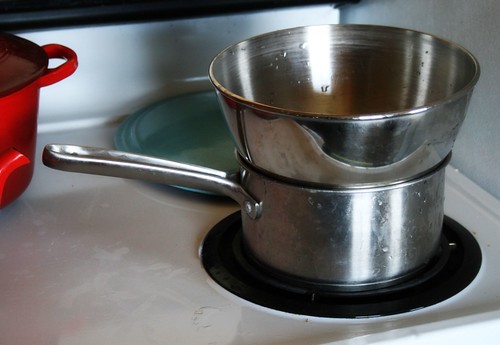
Day 2: By morning, your cream should have separated. Do not stir it. Fill a pot ¼ of the way with water and fit the bowl on top. The bottom half of the bowl should fit into the pot but should not be touching the water. For an image, click here (in this image the pot should be slightly larger or the bowl slightly smaller)
Heat gently to 82 C to scald the milk, but do NOT let it boil. Do not stir. Check the water level in about half an hour and refill if it has evaporated. After about 1½ - 2 hours it should have a thick uneven crust.
Remove the dish from the heat and leave it to stand in a cool place overnight, or until the cream underneath the crust reaches 45 C.
Day 3, or when the cream reaches 45 C: The cream can now be skimmed off the top and jarred (in sterilized jars, please!) or consumed immediately. Below you will have skim milk, which you can drink.